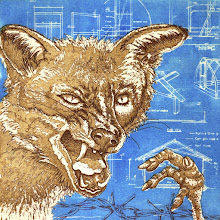
The Artists' Group has a new name and its own logo - get us! We will launch this on our 2014 calendar which will be available in November. We're receiving pre-orders already...
And here's the finished piece with drypoint Roman lamps and dice printed over the solar plate. Not sure how much of a sense of festiveness it gives but I'm quite pleased with the composition and movement in it.
Here is a proof of the first of my two-plate image for December. It's progressing very slowly and feels somewhat like pulling teeth. I don't know if it's down to some innate obstinacy but I really struggle with working to a brief rather than Doing My Own Thing - however wide the brief is. Anyway, I am gradually squeezing out an image. I'm thinking that this plate will be printed in blue and sepia, with a second drypoint plate over printed in a rich yellow (blue and gold were the predominant colours used during Saturnalia). I was going to used gold ink but I don't think that will reproduce well for the calendar. Normally I would have made an etching and aquatint but we're on quite a tight schedule for this project; tight for me anyway because I work oh so very slowly. I'm panicking a bit about meeting the deadline and solar plate is so much quicker, if less satisfying. I'm trying to see it as a good thing though as it's really challenging me and forcing me to work in different ways. I think I'm probably stuck in an etching rut a bit... and my output is fairly feeble so hopefully this is giving me the necessary kick up the backside.
Saturday, 10 August 2013
And so, on to the next project. The artists' group (we now have a name - more on that later) is producing a calendar
for 2014; we each drew a month at random and will make a print relevant
to that month. I drew December. No Christmas references from me - I'm basing mine on the Roman festival of Saturnalia which ran from 17 to 24
December. I guess in many ways it was like a precursor to how we
celebrate Christmas now as they did many of the things we do - feasting,
gift-giving, decorating their houses with greenery. However the Roman
festival was based around the worship of Saturn, god of agriculture, harvest and abundance. One of the
central elements was role reversal; masters dressed as slaves and
waited on their servants, and gambling, usually illegal was allowed at this time. More on this as the project progresses.
Creative opportunities are
coming thick and fast at the moment. Friday night, we had the private view of
Double Exposure, an exhibition of original prints by Red Hot Press members, and
a whole range of work, from painting, drawing and sculpture to digital
installations by the artists at unit11studios.
The exhibition is housed at
the recently reopened Wool House, a 14th Century building here in Southampton
that used to house the city's maritime museum. That was its last use anyway; as
the name suggests, it was originally build to store wool for export to the
continent. It's a wonderful place - a stone structure with a beautiful
wooden-beamed vaulted ceiling. The building has been closed for the last year
or so as the artefacts have been transferred to the new SeaCity Museum (once
the magistrates court).
The Wool House Project has
been set up by Element Arts, a group of local creative who are passionate about
the arts and really committed to doing what they can to promote it in the city.
As with all the small arts organisations in Southampton, they have no money and
are staffed by dedicated volunteers who give of their time generously. Element
Arts, Red Hot Press, A Space, the Art House to name just four; without these,
Southampton would revert to the near cultural dessert it was ten, fifteen years
ago. What a privilege it is to be involved in this burgeoning creative scene.
Here they are, all 25, printed, cut to size, numbered, titled and signed. Most satisfying. I finished printing them a couple of days ago and in the evening, when the last one had come off the press, I had the most contented feeling of completion. It felt almost like a ritual... ceremonial as I cleaned and dried the plate for the last time, covered it in grease, wrapped it, labelled it and stowed it carefully on the shelf with my other finished plates. It was a strange feeling; a feeling of finality but in a good way. The feeling of a job well done. Can't say I've noticed the feeling before... it wasn't unpleasant. It's been quite a long haul this project; it's been a few years since I printed an edition bigger than ten, and each of these took an hour to ink, wipe and pull. I only pulled two duff ones in an edition of 25 though so that's not bad. I've improved somewhat since the last big edition where I must have printed almost twice as many rejects as good prints. So, 20:20 is done, wrapped in tissue paper and ready to hand over (though not for a while yet) and it's straight on to the next project: the Artists' Group 2014 calendar. Watch this space.
The projects are coming thick and fast at the moment. The Artists' Group is about to start a new project (more of that in coming months) and I've just finished my plate for 20:20. 20:20 is a print exchange with a difference in that it works on a print workshop level. I'm taking part as a member of Red Hot Press of course; 20 of us are submitting our editions of 25 prints on paper 20 x 20 cm. It's run by Hot Bed Press in Salford - further detailshere.
Alektorophobia Etching, aquatint and spit bite 15 x 15 cm Edition: 25
That's what I learnt how to make this weekend at Red Hot Press. It was a great two-day workshop in which we created intaglio and relief plates. The above is a two-plate print; the sepia is intaglio and the yellow, relief (that's supposed to be a honeycomb by the way, not tyre tracks through road marking paint. Having painstakingly laid out the intaglio element of the print, I was rather winging it with the relief. I quite like it though - not bad for a first attempt).
My plan is to use this technique in conjunction with regular etching and possibly some monoprint thrown in for good measure. The detail you can get using the solar plates is amazing and far exceeded my expectations - the bug wings for example. I'd like to introduce some diagrammatic elements into my images and this technique seems ideal for that (it is an industrial process after all). Hopefully it will speed things up as well - no more spending a couple of days solid transferring copperplate handwriting backwards onto a plate!
The studio
is undergoing something of a transformation at the moment. I’ve been
using it for about four years now; it’s a lovely space and I feel very privileged
to have it but as I slide further into middle age, I find I’m struggling
with the lack of natural light in there. My eyesight seems to be deteriorating
exponentially and etching plates are particularly difficult to work on in poor
light.
So,
having had a good clear out (the studio was stuffed full of chicken paraphernalia
from over the winter and generally in a total mess), I removed some of the
shelving and racks on the walls and am in the process of painting them white. I’m about a third of the way done so far – painting brick is a
slow process – but already I’m noticing a difference. The next
job is to have the place completely rewired with more sockets and lighting
added. After that, I shall investigate some sky lights which is what will really
transform the place. So, watch this (creative) space.
Yes indeed, the work is
hung, the official opening had, the wine drunk and even a few prints and cards
sold. The show comprises a diverse range of work by ten members of the Red Hot
Press Artists’ Group and one of the studio directors: linocuts, card cuts, wood
engravings, wood cuts, collagraphs, mono prints, gum transfer prints, drypoint,
etchings and aquatints. All print life is here – well, most of it anyway.
Certainly we covered most of what Red Hot Press is able to offer facilities
for, the one exception being screen printing.
As
a group, we’ve only been meeting just over a year, so it was an ideal
opportunity to celebrate what we’ve been working on over that time; and having
a deadline to work towards is always a good motivator. It was great to see the
end products of projects we’d watched develop over the last few months, all of
which were of a very high standard. A thoroughly satisfying first outing for
the Artists’ Group.
Other artists' studios are fascinating so I found this very interesting programme about artists' studios on Radio 4 this week so gripping I had to listen three times. To be fair, the first time was in the car on the way home so I came in half way through, and the second time was in bed. It was getting on for midnight, so I dozed off and heard only the first half. Third time lucky... Well worth a listen on BBC iPlayer if you get a chance. It's available forever so no danger of missing it.
The presenter, Susan Aldworth, is a printmaker (even better!); she talks to, amongst others, Hossein Amirsadeghi about his new book Sanctuary, a photographic record of his visits to over hundred British artists in their studios. And their cats and dogs. I now need to get hold of a copy.
Finished this a
couple of weeks ago so it's framed and all ready to go, along with my
Korean roof tile. I took the latter to a different framer this time - one I've not
used before. It's always the same conversation though... Me: 'I'd like a plain, light wood frame please, and a mount as close as possible to the colour of the paper I've printed on.' Framer: 'That does absolutely nothing for the print - how about this frilly gold frame?' Me: (slightly irritably) 'It's not really supposed to; it would distract from the image.' Framer: 'We'll have to agree to disagree on that one. I'll just try this red frame...'
We have our flyers - really pleased with them. Good work Tim and Maureen. Just over a week to go now until we hang the show and there's lots to organise, especially for the opening.
FINALLY. Getting back to my core business of etching; this is an old piece I started a couple of years ago and got stuck with. We had a New Year, Old Project session at our January meeting of the Red Hot Press Artists' Group to which I took it - and received some very useful ideas on how to resolve the background. That coupled with the deadline for our May exhibition fast approaching, and I suddenly feel motivated to get creating again. This image isn't finished yet... thinking of printing some parts in sepia, some in black... a bit of experimentation needed yet. Only six weeks to go though...
Time for a chicken update I think. Flora, Aunt Ada and Cousin
Judith have been with us for three months now and what a full three months it’s
been. Flora has had a dodgy eye ever since she arrived but that seems to be
sorted now - after three trips to the vet, two courses of antibiotics and eye
surgery to remove a huge lump under the eyelid. Yes, vets do operate on
chickens. I could have had her despatched; after all, the vet bills would have
bought me fifteen more hens, but I guess I’m just too sentimental and wanted to
give the old girl a chance. Glad I did as she seems fine now.
Flora's fluffy bottom
Apart that is, from her penchant for plucking out and eating
Ada’s bottom feathers. Of course, chickens being what chickens are, Judith had
to get in on the act so poor old Ada has been walking around with a denuded
behind for a couple of weeks. It doesn't seem to bother her too much. Bought
some anti-pecking spray which seemed to work as the feathers were all growing
back nicely – she was looking satisfyingly fluffy- until the other evening when
I noticed she was bald again. Out with the spray again.
Aunt Ada's not sure about the snow; it comes all the way up to her plus fours!
The three of them have also diced with mycoplasmosis but
after more antibiotics seem to be clear at the moment. It's one of those
tenacious bugs that's hard to shift once it's in the flock but I'm hoping with
good bio security I can keep it at bay. Egg production is good and with my day-job
data analyst hat on, I'm keeping a log of daily, weekly and monthly egg
production against expenditure. From this I can calculate the cost of each egg
and map it against monies recouped using the supermarket price of an average of
28p per large woodland egg. More on this next time
Flora was the first to venture out into the snow
when I will do a detailed
analysis. You can take the person out of data but you can't take the data out
of the person.