|
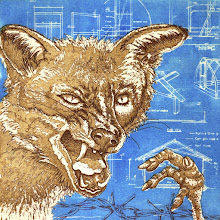
| At 36 ~ Freya Payne, etching, 2005 |
I wasn't yet etching when I first came across Freya Payne's work in Printmaking Today in 2006. I was getting some pretty good tone and texture with card cuts but there isn't that versatility of being able to rework and rework and rework the plate like there is with etching. It wasn't until 2009 that I began to use pine resin aquatints to attempt to achieve really tonal / textural effects with etching. And now, five years later, I still can't achieve anything like what Payne does with the plate.
 |
| Amateur ~ Freya Payne, 2007 |
I like portraiture and it remains integral to my work, but I guess my main focus is narrative. Some of Payne's earlier etchings have narrative themes. I particularly like the image below - rather Rego / Hanselaaresque.
 |
| Looking for exits - Freya Payne, 1998 |
In an interview with Katherine Jones (Printmaking Today, Summer 2006), Payne is asked what it is about printmaking that interests her. She replies:
'I love both the physical process and the extended possibilities of a way to draw. The stopping and starting, the slow alchemy of acids and metals; the way drawing becomes an accruing of marks, layer by layer, on a surface physical enough to handle so much alteration, but which still gives an image which feels complete - the journey of the making unified in the final image.
The prints are often testing grounds for installation or sculpture and get fed back into prints as props. The boundaries between what leads the work - concept or process - blur.'
 |
| Sisyphus ~ Freya Payne, 2007 |
On the subject of process, Payne says this:
'When all else is in flux, printmaking gives you somewhere to begin, some parameters, technical anchors. It also gives you a valuable space between the act of making and seeing the result. Often I have very black periods when I lose faith in what I'm doing; this space can be a life raft.'
How true this is. I've lost count of the times when I've become stuck with an image and found... comfort? Reassurance? New momentum? Simply by cleaning up the plate, degreasing, adding an aquatint and beginning to stop out. All begins to flow again. And the ritual of preparing a new plate when the image isn't fully formed in the mind - the process of filing down the edges, taping the back, degreasing and applying that first hard ground - then the image is ready to trickle onto the plate. I wonder if it's the same for painters preparing a canvas or sculptors doing whatever needs to be done to their chosen medium. I'd be interested to know.
 |
| To Turn Again ~ Freya Payne, 2007 |
 |
| Women ~ Freya Payne, 2008 |