Showing posts with label Southampton City Art Gallery. Show all posts

Saturday, 30 April 2016

Building on a Foundation at Southampton City Art Gallery

 
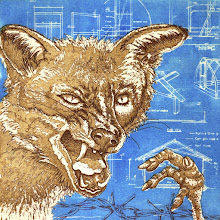
Prints by members of Red Hot Press are on show at Southampton City Art Gallery at the moment. I have two pieces on display - my dragon roof tile and of course, PB has to get in on the act! He wouldn't miss out! On until 24 June 2016.


Sunday, 13 December 2015

Jane Joseph: Seeing the Space

Jane Joseph ~ Foot bridge and Tower, etching
Interesting exhibition of drawings, etchings and linocuts by Jane Joseph on at Southampton City Art Gallery at the moment. I like the large charcoal drawings.

The artist has also curated an exhibition of drawings from the gallery's collection which is more interesting (to me at least). A couple of Auerbach's in there.

Friday, 9 October 2015

Ben Johnson, Spirit of Place: Paintings 1967 to 2015

Patio de los Arrayanes, 2015, acrylic on canvas, 220 x 220 cm

Went to see the Ben Johnson retrospective at  Southampton City Art Gallery this week. Many large, detailed, perfectly stencilled paintings, some of which are reputed to have taken 17 person years to make over a period of 18 months. 

I have to confess that largely, the photorealistic style leaves me cold, though I can appreciate the skill, concentration and sheer dedication to perfection and intricacy Johnson achieves in these works. This is extreme painting. Extreme painting.
Poolside reflection, 1984, acrylic on canvas, 159 x 217 cm
 
There are a couple of paintings of pools I like... they are a mass of layering of reflection and light and pattern which borders on abstraction. These are less straightforward representations of what the artists sees.

I won't beard on. Instead, listen to Johnson talking about his work here.
The Unattended Moment, 1993, acrylic on canvas, 184 x 243 cm


Sunday, 20 July 2014

From David Bomberg to Paula Rego: The London Group in Southampton

Marcel Hanselaar ~ Ritual, 2013, oil on canvas


Having said I wouldn’t be blogging much over the next few weeks, I am now going to blog…


About five weeks ago, the week the last Ofsted inspection finished, we moved offices at work and are now based in the Civic Centre. This meant going from a brand new building to one which was built in the 1931 and as it’s listed, has many of the original features (possibly including some of the plumbing…). It also houses the city art gallery and it so happens that our office is right next to the gallery and conservation studios. There is art just on the other side of the wall, literally. How tantalising. We often see works of art being taken from the conservation studio into the gallery too (oh cruel tormentors!). I am most definitely on the wrong side of the wall.

It does mean however, that I can sneak off for ten minutes every now and then, to visit a particular work. The current exhibition (From David Bomberg to Paula Rego: The London Group in Southampton), which I have yet to see properly, has a painting by one of my favourite artists, Marcelle Hanselaar. Ritual (above) is a wonderful piece by which I am much taken. I've been to visit it several times and the more I look at it, the more I like it. The central figure, light and colours are so atmospheric. I can't pretend to know what it means... I can only have a rough guess. I would very much like to know the painter's ideas behind this particular painting.

I will blog about this show again probably - it also has a Paula Rego aquatint. It's on until 1 November so plenty of time to go and see it. The art gallery opening times are a bit rubbish though (I can feel another rant coming on...); Monday to Friday 10am to 3pm and Saturday 10am until 5pm, closed Sundays. For a gallery which has such a fabulous collection to shut at 3pm in the week and close on Sundays is such a waste - but there we are, another thing we can thank Cameron and his budget cuts for. Yours, disgusted of Southampton.

Sunday, 11 May 2014

The Artists Rifles

Portrait of Frederic Lord Leighton by GF Watts


"Are you interested in rifles or are you just here to look at the paintings?"

This was the question posed to me by a gentleman whilst I was standing in front of the above painting at Southampton City Art Gallery last week. I assured hum I was there to look at the paintings; he, on the other hand, looked more of a military history sort of chap, so I wonder what he made of the show (there weren't any actual rifles).

Flowing to the Sea ~ John Everett Millais, 1871
I wasn't quite sure what to expect from this exhibition; here's what the blurb on the art gallery website says.

 'At the outbreak of World War I, Paul Nash, a prominent artist, gave up painting and enlisted in the Artists Rifles, eventually fighting with the Hampshire Regiment. Inspired by his story, this exhibition introduces the Artists Rifles, a volunteer regiment founded in 1860 under the threat of French invasion. Its early membership was a who’s who of the Victorian art world: Burne Jones, Rossetti, Millais, Leighton and Holman Hunt. The Great War saw a new stream of creative people join its ranks: Frank Dobson, Charles Jagger, Wilfred Owen, Edward Thomas and John Nash who went ‘over the top’ with the regiment in 1917. Follow a history of the regiment and its members through a selection of artworks, including loans from the Royal Academy, Imperial War Museum, British Council and Arts Council England.'


The idea of a regiment consisting entirely of artists, poets and other creative types seems somewhat bizarre - the phrase 'herding cats' springs to mind - and having seen the show, I still can't quite get my head around it. It is, however, an interesting mix of art and artifacts. 

Eurydice to Orpheus - Frederic Lord Leighton

There is a great deal of Pre-Raphaelite work, as you might expect - portraits and Victorian narrative paintings (which don't have anything to do with war or the Artists Rifles directly as far as I can tell). The work continues through WWI and WWII with etchings, drawings and paintings by both John and Paul Nash, as well as a series of 1930s (?) posters for fuel. There are many photographs and sketches of the regiment itself (with titles like 'Troops on Wimbledon Common after a skirmish' which baffled me - who could they be skirmishing with?! - until I discovered they trained on Wimbledon Common). There are also cases containing uniforms and various documents and publications relating to the regiment, plus plenty of information panels on the walls (most of which I confess I didn't read, because obviously, I was just there for the paintings...).It's an interesting show though, even if you're not interested in military history, or the Pre Raphaelites for that matter. I recommend it.

CE Perugini ~ Frederic Lord Leighton

Monday, 27 January 2014

Southampton: A City Lost… …and Found


Back to Eric Meadus. To accompany the exhibition at The First Gallery, Margery and Paul Clarke, who own and run the gallery, have put together a book of Meadus’s drawings. The book, titled Southampton: A City Lost…  …and Found, contains drawings made of various locations in Southampton with accompanying text about Meadus and his connection to those areas. There is also a rather good essay by local writer Philip Hoare about how the city has changed over the years particularly following the devastation of WWII.

Meadus experimented with different styles of drawing in the same way he did with painting. He seems to have settled finally on a quite stylised form of line drawing without tone or light and dark. These work very well and there are some good examples in the book, but those I like best are his location sketches. As records of places he visited to take back to the studio, these are a lot looser and freer and show just what a good artist he was. There’s a real vitality in these; the lines are quick and full of energy, the unfinished drawings showing all that he needed for reference at a later date. I can just imagine him standing on a street corner in his lunch hour, a race against time to get down the basics before returning to work to complete the day’s shift. These underpin all the work done later in the studio.
 
This is a really good book, one which I spent hours pouring over and to which I will come back again and again I think. Available to buy from The First Gallery and Southampton City Art Gallery. Well-worth a look.

Sunday, 19 January 2014

Eric Meadus Part Two: Composition


Park with Houses
Oil on board, 40.5 x 45.7 cm, Southampton City Art Gallery
Okay. Continuing from where I left off, Eric Meadus and composition. What do I want to say about this… I think it’s easy, at first glance, to conclude that Meadus’s work is rather naïve (guilty as charged, Sir) but again, the more of his paintings and drawings I look at, and the more familiar I become with them, I start to see that the compositions are really quite sophisticated. He was prepared to take chances too. Several of his paintings have large expanses of uncluttered sky or foreground such as Park with Houses (above). The placing of the buildings in a strip along the top third of the painting (Rule of Thirds; did Meadus know about this or was it intuition?) leaving the other two thirds as a great swathe of green shows his confidence. Many artists would have felt the need to fill the foreground, or at least have some detail to break it up. The subtle change of greens is all that’s needed to suggest perspective and a change in topography; the eye runs down the slope to the darker plateau assisted by the tree trunk drawing the gaze towards the lower part of the picture plane.


Townscape
Oil on board, 35.5 x 40.4 cm, Southampton City Art Gallery

In Townscape, the buildings take up just the bottom half of the picture with an unrelenting greyish sky spreading across the other. The houses are cropped and stretched and crowded together in a gentle upward slope suggesting squeezed urbanisation below an oppressive winter sky. 


Meadus plays with perspective; flattens out and warps the buildings. Walls almost seem to slide in front of each other to create architectural conundrums which work so well. Railway Station, possibly Woolston, Southampton is a good example. The end of the building, which should recede to the right looks like it has been peeled off the end of the building and pull out to lie parallel with the side. Somehow Meadus gets this to work – it doesn’t jar the eye at all.


Railway Station, possibly Woolston, Southampton
1964, oil on canvas, 49 x 53 cm, Southampton City Art Gallery

There’s loads more I could say about this but this post feels like it’s turning into a critical essay so I shall stop here for today. I still want to say something about his drawings and about his creative drive so I will be back on this subject soon. In the meantime, go and see the exhibitions for yourself and see if you agree with me.