Sunday, 15 January 2012
Thursday, 5 January 2012
You can’t keep an old etcher down
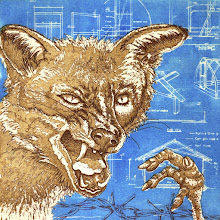
After a hiatus of about six months, it’s good to be etching again. I started this image as a wood engraving but the call of the aquatint was too strong, so here he is on a 20 x 30 cm zinc plate. I’m trying to work more quickly and haphazardly, not so meticulously with this one so we’ll see how that approach goes; I’m pleased with how he’s coming along so far though. Working on some text to go with the image now. Whilst I was at it, I mixed up a new batch of copper sulphate solution – quite a pleasing New Year ritual. The vibrant blue of the copper sulphate crystals and the way they turn green and yellow when mixed with salt and hot water, then back to a blue solution made me think of Spring. Not that I’m wishing my life away, but the days are getting longer now…
Friday, 30 December 2011
The Arnolfini in Bristol
I went to Bristol yesterday to see a friend and took the opportunity to visit the Arnolfini, the city’s contemporary art gallery. Bit of a nostalgia trip too – used to visit the gallery regularly when I was at art school just across the bridge in Wales. There are two exhibitions on in celebration of the Arnolfini's 50th anniversary. The first is Museum Show Part 2 which was a collection of ‘museums’ with titles such as the Museum on Non-Participation, the Museum of Television and the Museum of Forgotten History. This is the second part of a sort of survey of museums created by forty artists from around the world and consists of installations including a wide range of objects. The above image is the one I found most pleasing.
The second exhibition is Self-Portrait: Arnolfini by Neil Cummings; a series of water droplet-shaped patches with text on them arrange throughout the foyer and up the stairs of the gallery. The text gives various facts about the history of Bristol and the gallery starting from the Bristol Riots of 1831 through to 2061, 100 years after the gallery opened, as well as details of world organisations and advances in technology. The shapes are colour-coded: pale blue for the history of the Arnolfini and art in general, olive green for social and financial organisation and purple for technological innovation. The whole forms an elaborate timeline based on fact and flowing off into speculation - which actually drew me in more than I thought it would. Where the text which is purely speculative is laid out in exactly the same way as that which is historical fact, it's very easy to be sucked in to believing all is truth.
The Museum of Museums left me cold I’m afraid, as it seems most conceptual art does these days. I’ve been thinking about why this might be, having had a keen interest in it in the past. I can only assume that it’s because that brand of art is so far removed from my current situation, irrelevant to my life as it is now. I guess I just don’t have the time or mental energy to ponder these things anymore. Give me a painting by Vermeer or a Paula Rego etching any day - not that these aren’t thought-provoking of course; they most certainly are. They give me something conceptual art doesn’t though.
Tuesday, 20 December 2011
Origins
Over the last few months I’ve been thinking on and off about beginnings and endings, birth and death, and how development is affected by external factors. I was weaving this into an etched self-portrait but as my etching mojo seems to have taken what I hope is just a temporary leave of absence, I need to rethink and carry this work in a new direction and in a new medium. Foetuses are a rather obvious place to start as an emblem of new beginnings, but start there I shall. The drawing above is in the process of being transferred to a wood engraving block and will, I think, be surrounded by some text.
Finished frog
Sunday, 11 December 2011
First proof
Took the first proof off my block yesterday and here it is; pretty rough around the edges but not as bad as I thought it would be... although possibly looks more like a wood cut than a wood engraving. Needs some tidying up. Oh and I need to order some relief ink as my tin had completely dried up (had to print it using etching ink) – shows how long it’s been since I last did any wood engraving!Block size: 750 x 500 mm, 3 x 2 inches
Sunday, 4 December 2011
New glasses can wait
It seems I've found the solution to the problem of not being able to see what I'm doing on my wood block. Forget the new glasses; look what I found lying around in the studio (inherited from my father who was always making something and was very long sighted). This magnifying lens on a stand is the perfect size and shape – my sandbag fits exactly underneath. Working on the block this afternoon has been much easier. Well, from the point of seeing what I’m doing that is.
The image is very slowly taking shape – hope to be able to take a proof soon. My main problem is bruising the edges of the cuts with the bottom of the tool. I need to take some advice from Someone Who Knows about this and what I can do to stop it. I’m a bit embarrassed to show the block to a real wood engraver though as it’s so rough and badly done. Ah well, I’m not planning to use it for anything – it’s just for practice.
Sunday, 27 November 2011
I may need new glasses

Having made a start on a wood engraving, I am reminded of how fiendishly difficult and slow-going it is. I’m struggling to see what I’m doing too. After working on the block for an hour this afternoon, I scanned it and blew the image up large on my computer screen – what a mess! Shudder to think what’s going to come out when I finally get to the proofing stage. I’m beginning to regret adding the text – really fiddly. This is a maple block, 75 x 50 mm (approximately 3 x 2 inches).
Tuesday, 22 November 2011
Back to life

It’s funny how time stands still when you’re ill… time out of time. Life goes on around you and you sort of feel yourself slipping behind; whilst everyone else is hurtling towards December, I’m just shuffling into November. Back to work this week though, and it feels so good to be back in the world again, even though I’ve lost a month.
Sadly, the above frogs are all I’ve managed artistically during that time. I have a hankering to do some wood engraving or linocutting; just can’t seem to settle back into etching at the moment. I have done both before and found it really challenging as it’s a very different way of working and thinking. It doesn’t naturally suit my images which are well-rooted in intaglio techniques so it’ll be good for me to adapt my work accordingly. Interestingly circular as I started this blog to record my progress with wood engraving.
Sunday, 16 October 2011
What does it say?
Should all art have something to say? What does that actually mean - having 'something to say'? I was talking to someone at a gallery earlier this year who made the comment, 'I like art by artists who have something to say' and I've been thinking about it ever since.Obviously there's a lot of art which has a clear message, whether political, social, cultural or personal, but there's also much which is more ambiguous. Surely that must still say something to someone. Doesn't all art say something, even if it's just the artist showing what's in his/her head; another human being's experience of the world?
I really don't know. And I've lost sight of what my own work is saying, not least because I'm not really making at the moment. Maybe this isn't the best time to be pondering such questions; maybe the best thing is to just get back in the studio and do.
Wednesday, 28 September 2011
The perfect is the enemy of the good
As I look at the dodgy nose and badly-rendered mouth on the above sketch, I’m thinking about the following passage on perfection from Art & Fear: Observations on the Perils (and Rewards) of Artmaking by David Bayles and Ted Orland. ‘If you think good work is somehow synonymous with perfect work, you are headed for big trouble. Art is human; error is human; ergo, art is error. Inevitably, your work (like, uh, the preceding syllogism…) will be flawed. Why? Because you’re a human being, and only human beings, warts and all, make art. Without warts it is not clear what you would be, but clearly you wouldn’t be one of us.
Nonetheless, the belief persists among some artists (and lots of ex-artists) that doing art means doing things flawlessly – ignoring the fact that this prerequisite would disqualify most existing works of art. Indeed, it seems vastly more plausible to advance the counter-principle, namely that imperfection is not only a common ingredient in art, but very likely an essential ingredient. Ansel Adams, never one to mistake precision for perfection, often recalled the old adage that “the perfect is the enemy of the good”, his point being that if he waited for everything in the scene to be exactly right, he’d probably never make a photograph.
Adams was right: to require perfection is to invite paralysis. The pattern is predictable: as you see error in what you have done, you steer your work toward what you imagine you can do perfectly. You cling ever more tightly to what you already know you can do – away from risk and exploration, and possibly further from the work of your heart. You find reasons to procrastinate, since not to work is not to make mistakes. Believing that artwork should be perfect, you gradually become convinced that you cannot make such work. (You are correct.) Sooner or later, since you cannot do what you are trying to do, you quit. And in one of those perverse little ironies of life, only the pattern itself achieves perfection – a perfect death spiral: you misdirect your work; you stall; you quit.
To demand perfection is to deny your ordinary (and universal) humanity, as though you would be better off without it. Yet this humanity is the ultimate source of your work; your perfectionism denies you the very thing you need to get your work done. Getting on with your work requires a recognition that perfection itself is (paradoxically) a flawed concept. For Albert Einstein, even the seemingly perfect construct of mathematics yielded to his observation that “As far as the laws of mathematics refer to reality, they are not certain; and as far as they are certain, they do not refer to reality.” For Charles Darwin, evolution lay revealed when a perfect survival strategy for one generation became, in a changing world, a liability for its offspring. For you, the seed of your next artwork lies embedded in the imperfections of your current piece. Such imperfections (or mistakes, if you’re feeling particularly depressed about them today) are your guides – valuable, reliable, objective, non-judgemental guides – to matters you need to reconsider or develop further. It is precisely this interaction between the ideal and the real that locks your art into the real world, and gives meaning to both.’
Tuesday, 20 September 2011
Pen drawings
I recently bought a couple of fine-nibbed drawing pens. I used to draw in pen a lot; there’s something quite liberating about it. Not being able to rub out your mistakes means you don’t have to be precious about the drawing… it’s going to be a sketch rather than a finished piece. And somehow, that makes me draw better. Small, quick portraits like these. Freer, more energetic. The last was particularly interesting to do because this is a relatively new face, one I’m not that familiar with. Surprising what a difference that makes. Surprising how the features of a familiar face flow from the pen so readily. Maybe it’s not surprising at all; I’ve just not thought about it before.

Friday, 16 September 2011
The Flea
Here’s a doodle I started a couple of weeks ago in an effort to kick-start some etching (it hasn’t worked so far). The cat had issues with fleas last month – sorted now thank goodness – so a flea print had to be made of course. A friend suggested illustrating John Donne’s rather racy poem The flea; interesting metaphysical mind games. So here’s the beginnings of it. Needs more work however. Maybe I could market it as a Valentine card…How little that which thou deniest me is ;
It suck'd me first, and now sucks thee,
And in this flea our two bloods mingled be.
Thou know'st that this cannot be said
A sin, nor shame, nor loss of maidenhead ;
Yet this enjoys before it woo,
And pamper'd swells with one blood made of two ;
And this, alas ! is more than we would do.
O stay, three lives in one flea spare,
Where we almost, yea, more than married are.
This flea is you and I, and this
Our marriage bed, and marriage temple is.
Though parents grudge, and you, we're met,
And cloister'd in these living walls of jet.
Though use make you apt to kill me,
Let not to that self-murder added be,
And sacrilege, three sins in killing three.
Cruel and sudden, hast thou since
Purpled thy nail in blood of innocence?
Wherein could this flea guilty be,
Except in that drop which it suck'd from thee?
Yet thou triumph'st, and say'st that thou
Find'st not thyself nor me the weaker now.
'Tis true ; then learn how false fears be ;
Just so much honour, when thou yield'st to me,
Will waste, as this flea's death took life from thee.
Tuesday, 6 September 2011
I was Vermeer: the legend of the forger who swindled the Nazis
Originally his plan had been to create just one painting; when it
was declared as genuine, a newly discovered work by the great master himself, and
hanging in the Rijksmuseum, Van Meegeren would come clean. Confess and embarrass the art
world for they’re gullibility. He had always had a taste for high living
however, and went on to forge other works by Vermeer and some of his
contemporaries, amassing huge wealth in the process. It wasn’t until he
was forced to confess in 1945 that his career as a forger came to an end. Even
then, the authorities didn’t want to believe him so he was tried, rather
bizarrely, by ordeal; he spent two months painting a replica of one of his
fakes whilst watched constantly by a rotating shift of lawyers, prison guards,
art critics and journalists. At the end of this period it was no longer in
doubt that Göring’s painting was a fake and Van Meegeren’s status changed
from despised traitor to heroic rogue (Göring had given the art dealer a large
number of other Dutch paintings as part payment for the fake Vermeer; these
were restored to the nation).Saturday, 3 September 2011
Tinkering with drypoint and etching
These are some recent drypoint doodles just for something quick and easy to do. the second pull is actually better I think - the first is a bit too dark.
This etched pinecone isn't finished yet, needs more tone to 3D it up a bit (technical term). Maybe more line work, maybe some aquatint. Looking a bit lip-like at the moment. It's actually part of a larger image which I'm working on so the foul bite will be taken care of.