Wednesday, 9 February 2011

Garrick Palmer: A Life in Wood Engraving

2011 got off to a slow start for me due to two bouts of illness and a variety of domestic disasters involving broken cars, rotten kitchen floor joists and cracked toilet cisterns. Creatively, January was pretty much a bust.

February however began much more promisingly with a visit to Pallant House Gallery in Chichester to see an exhibition of wood engravings by Garrick Palmer. I first came across his work about five years ago when I was working on a series of card cuts based on Bartleby the Scrivener by Herman Melville. I found a copy of the Folio Society’s publication of the same from 1967 (Three Stories, Herman Melville) on ebay, illustrated by Palmer. Naturally I had to buy it, being very careful not to look at it until I had all my images established. I didn’t want to be influenced even subconsciously by another artist’s images of the story.

Garrick Palmer was born in Portsmouth in 1933 and studied Fine Art at Portsmouth College of Art and Design where he first learnt wood engraving, and at the Royal Academy Schools in London. He taught at Winchester School of Art from 1962 to 1986 where he was Head of the Foundation Department. This last is particularly interesting to me as I studied in that same department from 1987 to 1988 so missed him by a whisker; how annoying.

The retrospective exhibition brings together prints and book illustrations spanning Palmer’s whole career and includes many images of the English landscape, something he returns to time and time again and clearly loves. These are autobiographical to some extent, marking significant points in his life; his wife’s battle with cancer for instance, and when he himself was diagnosed with diabetes.

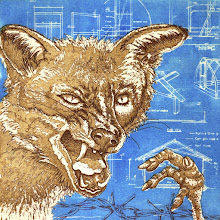
It was Palmer’s book illustrations I was drawn too though, particularly the nautically themed ones. His illustrations for Moby-Dick are breathtaking in complexity, composition and atmosphere, as are those for The Rime of the Ancient Mariner (the latter took ten years to complete). I found it hard to tear myself away from these. And although not my favourite of Palmer’s images, I was pleased to see an original copy of Bartleby himself. I love Melville’s story of the Wall Street Scrivener.

Not being a wood engaver myself, I don’t feel qualified to comment on his technique; I do know however, that he’s a master of it and if you’re at all interested in wood engraving, go and see this show before it finishes on 13 March.

Images:
Ancient Mariner II
Hampshire Fields

Monday, 27 December 2010

Temporary winter quarters

It was -2°C in the studio yesterday; the water in my plate-rinsing bowl had frozen over. That’s the coldest it’s been in there so far this winter (when I’ve wanted to work anyway) and even with the heater on, it’s not warm enough to ink up. So, I have decamped to the kitchen and utility room for the time being, with swift sorties to the studio to print.

I finished a plate yesterday which is satisfying; it’s taken me just over two months which is quite fast for me so I’m pleased with that too. My big problem is that I work so slowly, partly because I just don’t get much time to spend on my artwork these days. Or write blog posts; when was the last one…?

I’m glad this particular plate is finished because having worked on aluminium for the last few months, I can now go back to zinc which I prefer. This particular plate has come out peculiarly speckly in comparison with other aluminium plates I’ve worked on (see image with blog post dated 13 October 2010) and I have absolutely no idea why. Does aluminium have a ‘grain’? With zinc, I find I can get much cleaner lines and more variety of tone and texture. Shame it’s so much more expensive and not so easy to source and cut. Aluminium is great in that respect.

Well, that’ll be the last plate of the year; a very good time to finish it. Time now to reflect on what I’ve achieved over the last year and what’s coming up in the next. Some exciting firsts on the horizon for me - looking forward to it.

Saturday, 20 November 2010

Create from a place of no-mind

A friend lent me a book recently – The Power of Now by Eckhart Tolle. I’m not entirely sure where I stand with this fellow. He has some interesting things to say but I don’t like the way he writes (too mystical) and I’m uncomfortable with the way he’s set himself up as a kind of spiritual teacher. His ideas are drawn from many different religions and philosophies including Zen Buddhism, Sufism, Hinduism and the Bible. He talks a lot about mindfulness which I have a great interest in but there are other writers I prefer on this topic; Jon Kabat-Zinn and Russ Harris for example.

I thought I would share this excerpt about creativity from Tolle’s book which relates back to my posts Art practice as meditation? (May) and Doing non-doing (June).

‘The mind is essentially a survival machine. Attack and defense against other minds, gathering, storing, and analysing information – this is what it is good at, but it is not at all creative. All true artists, whether they know it or not, create from a place of no-mind, from inner stillness. The mind then gives form to the creative impulse or insight. Even the great scientists have reported that their creative breakthroughs came at a time of mental quietude. The surprising result of a nation-wide inquiry among America’s most eminent mathematicians, including Einstein, to find out their working methods, was that thinking “plays only a subordinate part in the brief, decisive phase of the creative act itself.” So I would say that the simple reason why the majority of scientists are not creative is not because they don’t know how to think but because they don’t know how to stop thinking!’

The Power of Now, Eckhart Tolle

Sunday, 14 November 2010

Bridget Riley: Flashback

I had an interesting afternoon at Southampton City Art Gallery taking in the Bridget Riley exhibition, Bridget Riley: Flashback. The show covers work from the early 60s up to more or less present day and includes some of her preparatory studies. These, many of which were plotted out on graph paper, took me right back to my to my student days at art school when most of my images were created using mathematical systems. Whereas the other students could be seen carrying sketchbooks, I was usually brandishing a pad of graph paper. Very different from the kind of work I’m making now.

There was a selection of books on Riley for browsing at the exhibition; ten or twelve with her customary op art images on the front. I was immediately drawn to the one with a conte sketch of a woman on the front. It seems that Riley was an ardent portrtaitist and spent her three years at Goldsmiths drawing, drawing, drawing from life. Although her work changed direction dramatically in the early 60s when she began to produce the sort of images she is so well known for, this early experience of looking and drawing has been crucial to the way she has worked throughout her career.


'A great deal is involuntary. At best the drawing seems to unfold
on the paper almost by itself, the hand being directly guided by the eye. Drawing is an exercise in looking: one finds out what can being seen and at the same time one finds oneself having to organise the visual and emotional information extracted. How to sort out and clarify this confusing wealth?'

Bridget Riley, From Life


Cataract 3, 1967

Sunday, 7 November 2010

Less swilling, more forming

I’ve a lot of ideas about my artwork swilling around in my head at the moment; swilling but not forming properly, which probably means my work needs to change direction. Portraits seem to be where I’m at right now but I’m still very much drawn to narrative images. As The Undertaker’s Nuptials seems to have stalled (temporarily I hope), I’m thinking about how I can work narrative into straight portraiture. This has lead me to consider how we all have our own personal stories; who we are, where we’ve come from, what’s shaped us, what’s important to us, where we’re going and so on.


I’m reading an interesting book at the moment – Portraiture by Shearer West. How about this:

‘Portraits are not just likenesses but works of art that engage with ideas of identity as they are perceived, represented, and understood in different times and places. ‘Identity’ can encompass the character, personality, social standing, relationships, profession, age, and gender of the portrait subject. These qualities are not fixed but are expressive of the expectations and circumstances of the time the portrait was made. These aspects of identity cannot be reproduced, but they can only be suggested or evoked. Thus although portraits depict individuals, it is often the typical or conventional – rather than unique – qualities of the subject that are stressed by the artist, as demonstrated in Holbein’s George Gisze. Portraiture has also been subject to major changes in artistic practice and convention. Even though most portraits retain some degree of verisimilitude, they are nonetheless products of prevailing artistic fashions and favoured styles, techniques, and media. Portraiture is thus a vast art category that offers a rich range of engagements with social, psychological, and artistic practices and expectations.’

Less swilling, more forming.

Image: Hans Holbein the Younger, George Gisze, 1532

Wednesday, 13 October 2010

It lives...!

Last week was a productive week. Not only did I finish a plate I’d been working on for far too long, but my website redesign was completed and the new site went live. The latter was courtesy of the excellent Martin Davis of Still-Moving.co.uk. The final result is quite different to how I originally envisaged it – and much better I think.

Tuesday, 21 September 2010

Green Door International Print Exchange 2010

Last week, I was really excited to receive my package from Green Door Print Studio in Derby containing prints by ten other participants in the exchange. This is the first time I’ve taken part and only the second year the exchange has been running; 103 printmakers from 11 different countries took part.

I’ve participated in other exchanges but this one has been the best so far, partly because it’s so well organised and professionally presented. The standard of work is high too. A particularly useful aspect is the personalised insert within the folio detailing whose prints I’ve received and who my prints have been sent to. Well done and thank you to the Johnson family for all their hard work.

I received prints from Candice Perry, Chris Rollins, Gina Louthian-Stanley, Judith G Leppert, Julianna Joos, Kirsten Kinnear, Michelle Keegan and Pat Crombie. These should be available to view on the exchange website shortly.

Saturday, 11 September 2010

Printing for Etsy

The last couple of weeks have been enjoyably busy in a printmakerly way. I spent a large part of the bank holiday weekend holed up in the studio looking through packaged prints and printing older plates to ‘stock’ my Etsy shop. I rarely revisit old plates, even though I haven’t printed the whole edition, but it was quite fun relearning the plates… remembering where to wipe more for cleaner whites, where to let the ink sit for a richer tone, which to tonk before pulling the final print. No sales on Etsy yet but a couple of my prints have been included in treasuries (these are themed collections of items for sale which Etsy members put together and publish on the site; a little help with advertising has to be a good thing).

I also had a meeting with a web designer to discuss revamping my website – get me! That made me really think about my target audience and the message I want to give. I learnt some useful stuff about marketing and how the web works so I’m all fired up to get the overhaul underway.

Tuesday, 24 August 2010

Summer's almost over


It seems that summer is nearly over; there’s definitely something autumnal about the early mornings now. As we’re preparing for the start of a new academic year, and as I’ve had a seriously uncreative summer, this feels like a good time to review where I’m at with my printmaking projects.

Production has been slow over the last year or so, partly owing to learning new techniques and partly by experiencing a creative bottleneck (there’s also that little thing called life which tends to get in the way too). I’ve not taken up so many exhibiting opportunities this year so I’m feeling the need to focus on getting my work out there.

Two things which have been on my To Do list for some time are overhauling my website and setting up an Etsy shop. The first I’m going to need some help with but the second I’ve already made a start on. The shop is set up and I’ve listed a couple of prints already. Now comes the fun part of seeing what else I have in stock and what needs printing. Who knows if I’ll make any sales but I’ve nothing to lose in trying.

Tuesday, 6 July 2010

Painting is good for me...

It was a varied couple of days in the studio this weekend. I spent time working on an etching (printing and aquatinting) and did some layout and design on a leaflet for a friend who’s just going into business; two quite different activities.


I also threw some painting into the mix. A big box of oil paints and gesso arrived on Friday, so on Sunday, I started a self portrait (24” by 18”). It was a very interesting experience. I don’t like what I produced but considering it’s been about 23 years since I last painted (and never in oils), it could have been a lot worse! A portrait was maybe a little ambitious to start with but it’s what I’m drawn to (pardon the pun).


My etchings are predominantly monochrome so using colour will be good practice for me. I enjoyed the freedom and immediacy of mixing the paint and moving it around on the gessoed surface, being able to build up layers so quickly. The etching process takes so long – which I quite enjoy – but it made a pleasant change to be able to work swiftly with the paint.


Even though this was very much a practice piece, I want to work on it some more, playing with colour and light and dark. I was surprised to find this afternoon that most of the paint is dry already, just two days after it was painted. I was expecting it to take much longer. My knowledge of the technicalities of oil painting is virtually non-existent so steep learning curve ahead.


Sunday, 27 June 2010

Diverting from my core business

Just recently, I’ve developed a strong desire to paint. Odd because in the last six years, I’ve been rather stubborn about NOT painting, seeing myself as a hardcore printmaker and nothing else. Short-sighted I admit; several people have told me lately that painting would help my etching, especially now that I’m using aquatint in quite a painterly way. I blame my old adversary, time – there never seems to be enough of it for printmaking, never mind painting.


I’m not sure exactly what’s triggered this urge to paint. There have been a number of contributing factors I think. Recently I taught a portrait drawing class to twenty-five or so members of a local art society which was great fun and took me outside printmaking. My students obviously enjoyed it too as I have been asked to do some more sessions with them. I’ve been looking at a lot of painters too of late – or should I say relooking. They’re all artists whose work I’ve admired for years; Lucian Freud, Caravaggio, Stuart Luke Gatherer. The cream of international portrait painting is now on show at the BP Portrait Awards which has just opened at the National Portrait Gallery (it’ll be interesting to see if visitor numbers are lower this year). And of course there’s dear old Flagstaff Jim feverishly painting away out there in the Arizona desert; a constant source of inspiration for me.

I love etching and still have much to learn and master, but I think part of the painting urge has to do with size. I’m limited in how big I can work by my press and I think I want to work really large for a change. My head is reasoning with my intuition and says that practically, it’s not a good thing to do (time, space, cost…) but my intuition says do it. And as I’ve decided (rationally of course) that I need to listen to the latter more, it’s time to head off to buy paint.


Top: Self-Portrait: Reflection, Lucian Freud, 2002
Middle: Lucian Freud
Bottom: Decisions, Stuart Luke Gatherer


Saturday, 19 June 2010

Doing non-doing

Following on from my Art practice as meditation? post, I thought I’d share a passage of the book I’m reading at the moment – Wherever You Go, There You Are by mindfulness expert Jon Kabat-Zinn.


‘Non-doing has nothing to do with being indolent or passive. Quite the contrary. It takes great courage and energy to cultivate non-doing, both in stillness and activity. Nor is it easy to make a special time for non-doing and to keep at it in the face of everything in our lives which needs to be done.


But non-doing doesn’t have to be threatening to people who feel they always have to get things done. They might find they get even more “done,” and done better, by practicing non-doing. Non-doing simply means letting things be and allowing them to unfold in their own way. Enormous effort can be involved, but it is a graceful, knowledgeable, effortless effort, a “doerless doing,” cultivated over a lifetime.


Effortless activity happens at moments in dance and in sports at the highest levels of performance; when it does, it takes everybody’s breath away. But it also happens in every area of human activity, from painting to car repair to parenting. Years of practice and experience combine on some occasions, giving rise to a new capacity to let execution unfold beyond technique, beyond exertion, beyond thinking. Action then becomes a pure expression of art, of being, of letting go of all doing – a merging of mind and body in motion. We thrill in watching a superb performance, whether athletic or artistic, because it allows us to participate in the magic of true mastery, to be uplifted, if only briefly, and perhaps to share in the intention that each of us, in our own way, might touch such moments of grace and harmony in the living of our own lives.’

Monday, 31 May 2010

The Royal Society of Painter-Printmakers Annual Exhibition

I sloshed my way up to the Bankside Gallery in London on Saturday to have a look at the annual RE show which was as rich and varied as always. It’s a bit of a two-edged sword for me because I find it inspiring and motivating but at the same time, a bit depressing as it reminds me of how little time I get to work on my art.


A print that really caught my eye was Decadensian by Frederick Morris, a newly-elected student member of the Society. This large etching and aquatint appealed to my penchant for atmosphere and narrative. It reminded me of an updated version of Hogarth’s Gin Lane although rather darker and more chaotic if that can be imagined.


During the duration of the show, several of the participants have given demonstrations of their particular medium; Angie Lewin and Gail Brodholt were giving linocut and wood engraving demos on Saturday. Still to come are demonstrations in linocutting, wood engraving and etching by Roy Willingham, Daphne Casdagli and Kate Dicker. The show ends on Sunday 6 June.

Sunday, 23 May 2010

Art practice as meditation?

I’ve developed an interest in meditation recently. This had nothing to do with my art making initially; it was in response to the emotional and physical strain of over two years of caring for elderly parents with dementia whilst trying to juggle the day job as a children’s social care data analyst, make art, run a home and have a social life. Throw in the countless other things that have to be dealt with and it leaves my brain feeling a little fried at times, something that a lot of people can sympathise with I’m sure. Life for most people these days is hectic at best.

I’m not sure what lead me to meditation but having read up a bit, there’s a lot of research which seems to suggest it’s a good thing for emotional, mental and physical health. My main aim is to find space to calm my mind and therefore help it to function better in day-to-day life. I’m not by nature a patient person, so this is going to be a test of my discipline and perseverance; there won’t be a miraculous overnight improvement.

I’ve been reading about brain activity in relation to meditation. There are four kinds of brainwaves apparently; alpha, beta, delta and theta. As I understand it, the mind is in a beta brainwave state most of the day when we are awake and active; thinking, talking, dealing with a huge range of stimuli and abstract thoughts about the past and future. These are the fastest brainwaves. Alpha brainwaves are slower; the mind is in this state when relaxed but still alert. We are receptive; not thinking but sensing, feeling and very much in the moment. Meditation induces this brainwave state apparently. Delta and theta brainwaves relate to sleep.

Where does this fit in with art practice? Over the years, I’ve had a number of conversations with people about what’s going through my mind when I’m working on a plate or a drawing. It sounds rather esoteric and a bit tree-hugging but the only way I’ve been able to describe it is as an almost zen-like state where I’m not really thinking about anything, just focusing on the artwork. I don’t think I even really think about what I’m working on; it’s almost as if my hands are working automatically. Thoughts come and go but I’m not really aware of them. As I said above, I’m not a patient person and the thought of starting a new piece of work can be daunting; and yet, when I’m working on a plate, I find I can work on a small area for hours without any kind of fatigue or irritation. It takes as long as it takes. In fact, I find it peaceful and restful. So I’m assuming that my mind must be in an alpha brainwave state and therefore in the same state as it would be during meditation. This is a very good thing and I obviously need to find time (somehow) to do more of it!

Monday, 3 May 2010

The Undertaker's Nuptials: the Datamonger

‘Good morning Mr Spearman!’


As the clatter of the shop door closing subsided, all rattling glass and jangling bells, a behatted head appeared above the counter.


‘Ah. Miss Moir.’


‘I have some choice samples for you today Mr Spearman.’ Lycoris Moir reached inside her oversized gabardine and pulled out her notebook with a flourish. The pages flapped and a fine shower of what one would imagine was dust fluttered out and tumbled in the air, catching the sunlight. Instinctively Spearman went to reach forward, then checked himself.


‘Careful Miss Moir, you’ll be spoiling the contraband.’ Spearman’s boot-button eyes blinked rapidly; he appeared nervous.


‘Nonsense Mr Spearman! Contraband indeed! This is a perfectly legitimate service we perform. If only people knew Mr Spearman, if only people knew. They would thank us. Indeed.’ The datamonger looked doubtful and noticing some coppery specks on the glass counter, snatched a cloth from somewhere behind him and rubbed quickly at the glass. It left a smear. Beneath lay large enamel trays containing numbers; some made of copper, some brass, and of varying sizes, piled up just anyhow.


‘I hear Mr Wheelwright’s had a busy week,’ Spearman stuffed the cloth into the back pocket of his trousers and manoeuvred his bulk around Lycoris and hurried to the door. He pushed across the two bolts and let slip the catch so that the door was locked and turned the open sign around to read CLOSED to any potential customers. He scuttled back round Lycoris, who had remained where she was, unmoved by his obvious unease, and towards a doorway at the back of the shop. Spearman drew aside the beaded curtain and extended a hand towards Lycoris, a beckoning gesture.


‘Do come through Miss Moir.’